
Full mouth reconstruction is one of the most transformative things modern dentistry can do — and also one of the most misunderstood.
It is not a single procedure, and it is not the same as a cosmetic smile makeover. It is a coordinated plan that rebuilds the health, function, and appearance of an entire mouth, often combining several types of treatment into one sequenced approach.
If you are researching your options, this guide explains what full mouth reconstruction involves, who it is for, the building blocks a plan can draw from, and how those pieces come together into a sequence that makes sense for you. Art of Modern Dentistry handles reconstructive, cosmetic, and specialty care in-house at its Lincoln Park and South Loop offices, which allows a complex plan to be coordinated under one roof.
What Full Mouth Reconstruction Is — and How It Differs From a Smile Makeover
A smile makeover is primarily cosmetic and elective: it improves how your smile looks, often with veneers, bonding, or whitening. Full mouth reconstruction is broader and usually necessary rather than optional. It restores function and health across the whole mouth — the ability to chew, a stable bite, healthy gums, and structurally sound teeth — while also improving appearance. People who need reconstruction are typically dealing with widespread damage, not a single imperfect tooth.

Who Is a Candidate
Full mouth reconstruction is considered when problems are extensive and interconnected. Common situations include multiple missing teeth, severe wear from grinding, numerous failing or damaged restorations, advanced tooth decay across the mouth, the effects of advanced gum disease, traumatic injury, or a collapsed or painful bite. A TMJ disorder or chronic jaw pain can also be part of the picture. If several of these overlap, treating them as one coordinated plan usually produces a better, more durable result than addressing each in isolation.
The Building Blocks of a Reconstruction Plan
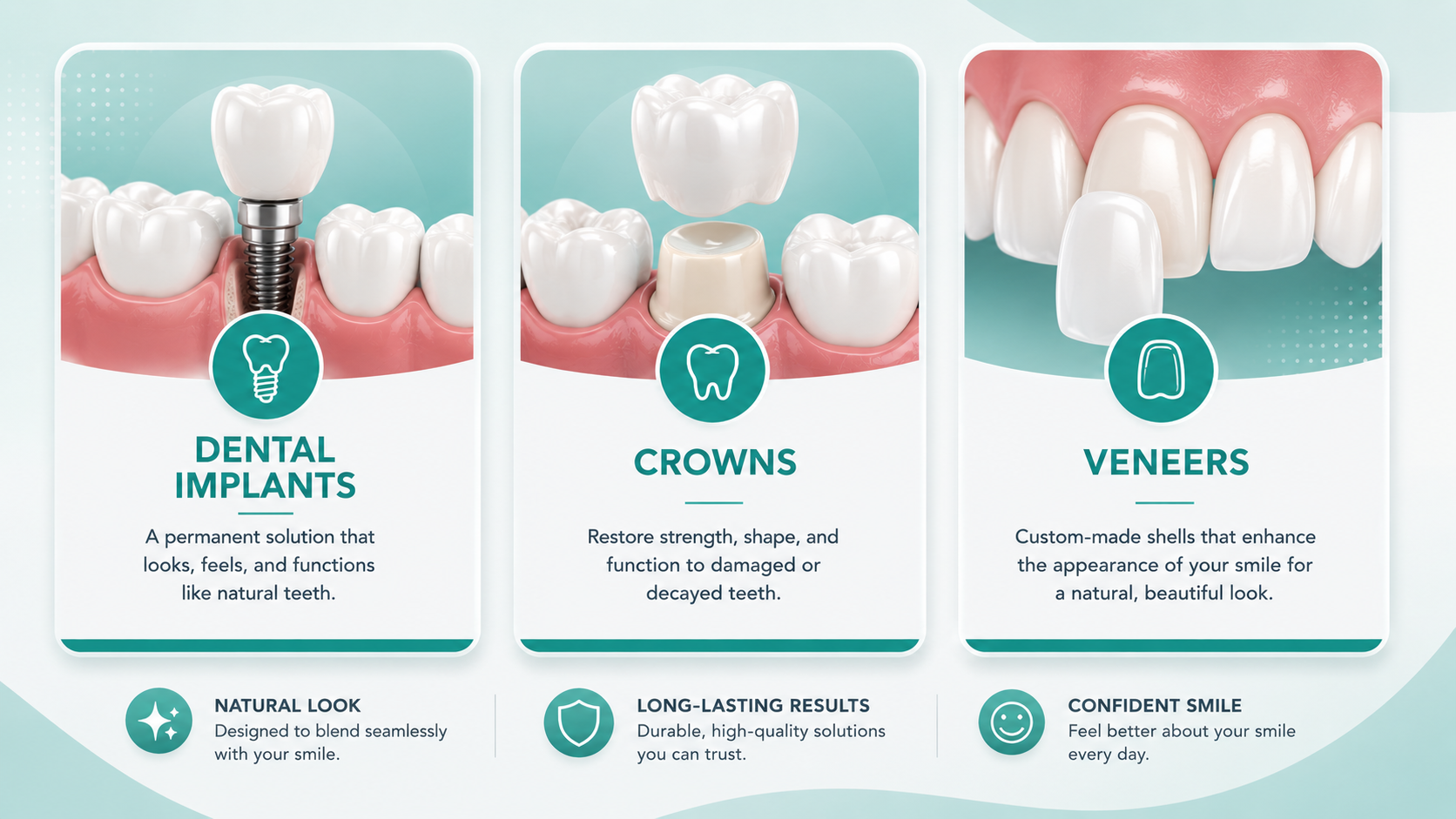
- Restorative foundations Crowns rebuild and protect individual damaged teeth, while bridges replace missing teeth by spanning a gap. These are frequently the workhorses of a reconstruction.
- Tooth replacementDental implants replace missing teeth at the root, and for patients missing a full arch, an implant-supported solution such as All-on-4 can rebuild an entire upper or lower set. Implants also protect the jawbone that tends to deteriorate where teeth are lost.
- Cosmetic refinementOnce health and function are restored, veneers, bonding, and whitening of natural teeth refine the final appearance so the rebuilt smile looks natural and cohesive.
- Periodontal careA reconstruction can only succeed on a healthy foundation. If gum disease is present, periodontal treatment comes first to stabilize the tissue and bone that everything else relies on.
- Endodontic and bite-related careRoot canal therapy saves teeth worth keeping, and addressing the bite — including any TMJ involvement — ensures the rebuilt mouth functions comfortably rather than recreating the problems that caused the damage.
How the Plan Comes Together
The defining feature of full mouth reconstruction is that nothing is decided in isolation. It begins with comprehensive diagnostics: a detailed examination, advanced 3D imaging to assess bone and structures, an evaluation of the bite and jaw joint, and a review of gum health. From that, your dentist designs a sequence — the order in which treatments happen so that each step supports the next. Stabilizing health and the bite generally comes before the final cosmetic layer, because the goal is a result that lasts, not just one that looks good on day one.

A Typical Sequence and Timeline
Because every reconstruction is individual, there is no fixed timeline — but most follow a recognizable arc. First comes diagnosis and planning. Next, any urgent or foundational issues are addressed: active infection, gum disease, or teeth that cannot be saved. Then the structural rebuilding happens — implants, crowns, bridges — often with healing time built in between surgical and restorative phases. Finally, the cosmetic refinements complete the smile. Some reconstructions unfold over several months; more complex cases take longer. Your plan includes a realistic timeline so you know what to expect at each stage.
Comfort and Technology During Treatment
A reconstruction is a journey, and comfort matters at every step. Art of Modern Dentistry combines advanced 3D imaging and digital planning with comfort-focused tools and sedation options, so that even involved treatment is as manageable as possible. Coordinating the entire plan within one practice also means fewer handoffs and a team that understands the whole picture of your mouth, not just one part of it.
Frequently Asked Questions
What is the difference between full mouth reconstruction and a smile makeover?
How long does full mouth reconstruction take?
How much does full mouth reconstruction cost?
Is full mouth reconstruction painful?
Will my reconstructed smile look natural?
Explore Your Full Mouth Reconstruction Options in Chicago
If you are facing extensive dental problems, a coordinated plan is almost always better than treating each issue alone. Art of Modern Dentistry can evaluate your situation and map out a reconstruction tailored to your health, function, and goals.